Simple Heuristic for Estimating WIP Containers
One of the problems I worked on was how to estimate average WIP in terms of number of WIP containers, not just part quantity. That mattered because container count is what really drives the floor space required, which in turn matters when looking at layout changes.
The issue was that the ERP issued work orders based on part quantity, and that quantity logic was basically the same across a variety of parts with different sizes. In practice, those work orders were used as paper travelers that stayed with the WIP container. Since the quantity on a single work order was often split across multiple containers, it was common to see several filled containers all carrying copies of the same traveler.
A straightforward fix might have been to set the work order minimum quantity equal to the capacity of each WIP container. But that would have created a lot more unique work orders, and operators would then have to print and track multiple travelers every time production overflowed into another container. Copying the same traveler was simply easier on the floor. Ideally, the work order logic itself should have been redesigned, but doing that for 2,000+ injection molded SKUs was a much bigger undertaking.
So the practical question became whether there was a simple heuristic for estimating WIP containers using parameters that already exist in the ERP?
The “useful” parameters loaded (necessary for backflush) in the ERP for each SKU were:-
- Material of the Part
- Single part weight
At a common-sense level, the relationship was obvious: bigger parts need more containers, while smaller parts fit more parts per container and therefore need fewer containers for the same quantity. To find an appropriate heuristic, I started by weighing filled containers to find the number of parts in them and plotting it with the individual part weight.
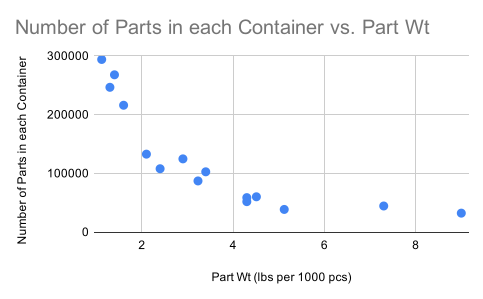
Plotting these variables did not give a linear graph but changing the axis to log-log gives an almost straight line.
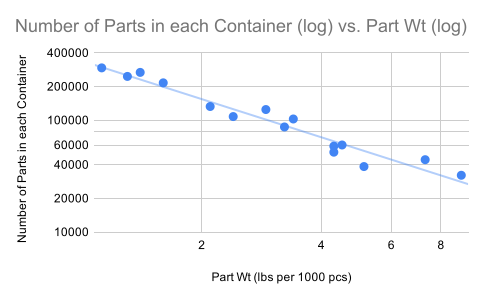
So why is there a linear relationship between the logs of these variables? A simple way to think about it is that the number of parts in a container should roughly depend on :-
But the part bounding volume can vary with the shape of the part but roughly,
Therefore,
As the container volume is constant and for a fixed material, taking log on both sides,
The regression line from the log-log graph gives an equation of the following form to estimate the quantity in each bin:
Here, k should be roughly close to 1 and the reason it deviates from 1 is factors such as packing density, geometry of the shape, etc. The value of C is based on the constant parameters such as the container volume and material density.
That gave me a usable heuristic to estimate the number of parts in a WIP container from data already available in the ERP. From there, it became much easier to estimate WIP in terms of container count, which was the metric I actually needed for layout and space analysis.